Good practice: What Het Geuzenhuis learnt from its first open call
The Geuzenhuis is a meeting place for liberal humanism in Ghent. With a packed programme of events, and certainly also through its magazine De Geus, the organisation aims to bring its work and themes to a wide audience. For each edition of De Geus, Gerbrich Reynaert, as the Geuzenhuis’s in-house graphic designer, seeks out a suitable cover image that fits the issue’s theme. “Images and language must be equally powerful to achieve something and to get your message across,” she explains. Her search always takes a different course, although she often finds that liberal humanism, apart from the torch symbol, tends to have a limited visual vocabulary.
“The idea came about in 2024, when we were celebrating Geuzenhuis’s 50th anniversary. To mark the occasion in a festive way, we launched our first open call. Our aim was to showcase a piece by a young artist,” explains Heleen, communications manager at Geuzenhuis. “An open call seemed like an interesting way to highlight young people’s perspectives on liberalism.”
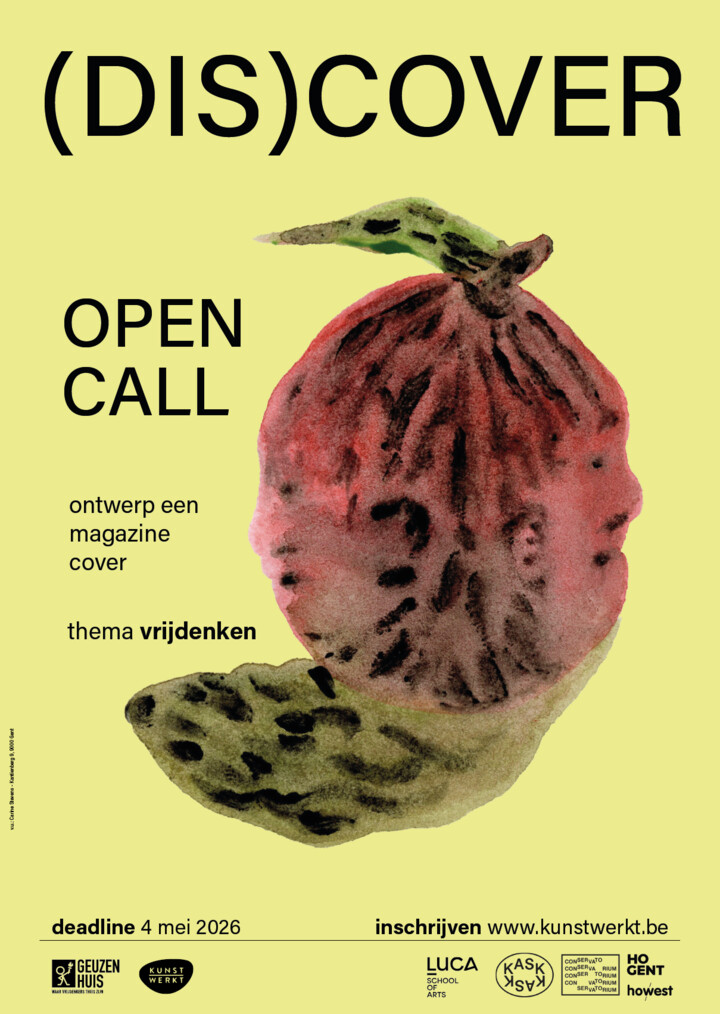
In collaboration with LUCA School of Arts and KASK & Conservatorium Gent, they launched their first open call in 2025, aimed at students – a target audience they felt was under-represented amongst their own members. And that is how they found their first cover, by Riet Van Lysebettens. A gentle image that fitted perfectly with their theme. “The number of entries wasn’t that high at the time,” adds Heleen. “Many factors played a part in that. Although we were particularly delighted with the collaboration with Riet, we were also very keen not to stop at just one open call.”
This spring, they launched a new open call under the title ‘(DIS)COVER’ on Kunstwerkt’s opportunities platform. Adopting the same approach, but informed by the lessons of the past, they set out to find a suitable candidate and once again found a successful match. Jacob Lambrecht won over the jury unanimously with an image that fits perfectly with De Geus’s rebellious image.
But an open call is not a quick search, as the Geuzenhuis has also learnt from this edition. “An open call requires more effort than actively seeking out a strong image yourself,” Gerbrich begins. “But it brings much greater returns for your organisation. As well as discovering the winner, you also get to know other artists, and you reflect on the process together with colleagues.”
Moreover, an open call is not a matter of luck; you have to see it as a process: every edition is an experience, in which you can emphasise different aspects each time.

Four lessons from Het Geuzenhuis:
Would you like to organise an open call yourself? Het Geuzenhuis shares its initial lessons below:
-
Good partners make all the difference
For the second edition, the Geuzenhuis opted for a broader approach. They used Kunstwerkt’s jury tool, which meant the open call immediately reached a large group of artists.
Promoting your open call on your own can be very tiring, especially if you want to reach beyond your own target audience. You should therefore collaborate specifically with organisations that have their finger on the pulse, or that can put you in touch with the right artists.
-
Learn from your jury members
Don’t just ask yourself, ‘Who’s on the jury?’, but also, ‘What expertise do I need?’. Put together your team of jury members strategically, as this will also enrich your decision-making process. “A cover image must be more than just beautiful,” Gerbrich continues. “It must also work within a specific format and context. By engaging in dialogue with others, I also learn to look at work in a different way. This, in turn, provides a great deal of inspiration for the rest of the organisation.”
-
Oversharing
“For this open call, we used a striking image by Riet Van Lysebettens, the winner of our previous competition,” explains Heleen. “We printed her image on postcards, which we distributed specifically to places such as LUCA School of Arts and KASK & Conservatorium Gent.” Heleen also shared the image widely online. For instance, she chose to share the image via Instagram and in specific Facebook groups for artists. An ideal way to reach beyond your own familiar channels.
-
Tailor your timing to your target audience
Looking to reach young people? Then be sure to check the academic calendar and take it into account. Once students have settled into their studios to work on their final projects, or are focused on exam periods, they’ve little time left for anything extra.